'Pure nostalgia' - Throwback pictures from the last time Ireland reached World Cup in 2002
Search


26 Mar 2026

Please allow ads as they help fund our trusted local news content.
Kindly add us to your ad blocker whitelist.
If you want further access to Ireland's best local journalism, consider contributing and/or subscribing to our free daily Newsletter .
Support our mission and join our community now.
To continue reading this article, you can subscribe for as little as €0.50 per week which will also give you access to all of our premium content and archived articles!
Alternatively, you can pay €0.50 per article, capped at €1 per day.
Thank you for supporting Ireland's best local journalism!

Research from university in Kildare helps to highlight barriers facing Traveller and Roma students. File photograph showing Maynooth University

A university based in North Kildare yesterday (May 7 last) has helped to publish a report outlining the educational barriers faced by students who are of Irish Traveller or Roma heritage.
According to the report — which is titled "A Community Needs Analysis with Traveller and Roma Students on Their Experiences of Higher Education: A Call to Action for Accountable and Transformative Policy and Practice Throughout the Higher Education System" — was made up of research which partially came from Maynooth University (MU).
The report, which was launched by Marian Harkin TD, Minister of State for Further and Higher Education, Research, Innovation and Science, indicates that Irish Traveller and Roma students continue to face persistent and systemic barriers in higher education.
The research was conducted by College Connect, a collaborative initiative of four higher education institutions — Maynooth University, Dublin City University, Dundalk Institute of Technology, and Technological University of the Shannon: Midlands Midwest. In addition, the report was developed in partnership with the National Traveller Women’s Forum and supported by Pavee Point.
According to MU, the research centered "on the voices of 32 Traveller and Roma students and offers powerful insights into the experiences of racism, financial hardship and the pressure to conceal identity that many face".
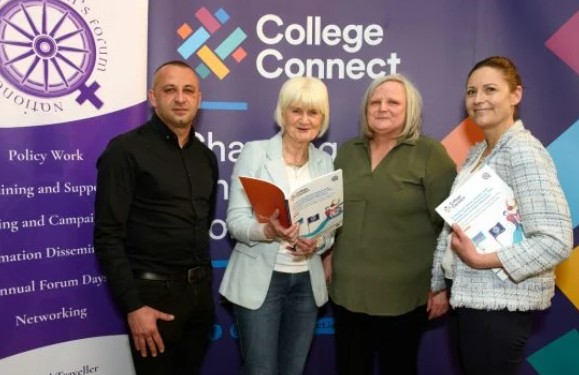
L-R: Rudolf Simonic, Roma Community Development Worker at Pavee Point, Marian Harkin TD, Minister of State at the Department of Further and Higher Education, Research, Innovation and Science, Maria Joyce, Co-ordinator of the National Traveller Women’s Forum, Dr Gemma Irvine, MU's Vice President of Equality & Diversity. Photo credit: Maynooth University
Key findings from the research reveal distinct challenges for Traveller and Roma students. These include shared experiences of significant, persistent structural racism and intergenerational trauma stemming from discrimination throughout their educational journeys, which can often be accompanied by low expectations from educators.
One student shared: "Throughout my educational journey, I hid my identity… because it’s a defence mechanism to have equal treatment."
Other students described a lack of belonging and uncertainty about their right to access support.
'RESILIENCE AND DETERMINATION'
However, despite these challenges, the report also highlights resilience and determination, with many students calling for action to ensure that future generations have a more inclusive experience in higher education.
The report calls for the development of a Traveller and Roma Higher Education Inclusion Strategy and contains eleven key recommendations including:
Speaking about the report, Minister Harkin TD welcomed it, but emphasised that although Irish society has made "positive progress" in recent years in creating better conditions and more opportunities for ITraveller and Roma students to access and succeed in higher education, there is "still have much work ahead in this regard".
Minister Harkin TD added: "As we move forward with implementing the new 'Traveller and Roma Education Strategy 2024 to 2030' alongside our colleagues in the Department of Education and Youth and the Department of Children, Disability and Equality, and continue our work on the 'National Access Plan 2022 to 2028', the recommended actions within this report will assist us in fulfilling our Department's commitments to the strategy's objectives."
Lead researcher Eilís Ní Chorcora, also said that Traveller and Roma students "should not have to navigate these systems alone".
"The absence of a coordinated national response creates risk, both to individual wellbeing and to institutional integrity," Ms Ní Chorcora elaborated. "This report provides a roadmap for change — developed with, and for, students themselves."
The full report can be read here available here.
READ NEXT: Plans granted for €576k extension to Aldi store in Naas, Kildare

Subscribe or register today to discover more from DonegalLive.ie
Buy the e-paper of the Donegal Democrat, Donegal People's Press, Donegal Post and Inish Times here for instant access to Donegal's premier news titles.
Keep up with the latest news from Donegal with our daily newsletter featuring the most important stories of the day delivered to your inbox every evening at 5pm.

This publication supports the work of the Press Council of Ireland and Office of the Press Ombudsman, and our staff operate within the Code of Practice of the Press Council. You can obtain a copy of the Code, or contact the Council, at www.presscouncil.ie, Lo-call 1800 208 080 or email: info@presscouncil.ie.