

KILDARE OPINION: The woman behind the legend of St Brigid
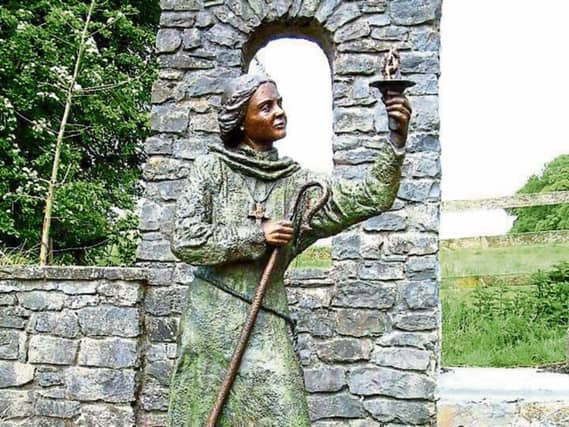

Paula Campbell gives her views
St Brigid’s day is fast approaching but what do we really know about the patron saint of Kildare?
Delving into her story reveals a woman who was not only a feminist with a colourful past but also a trailblazer shunning the traditional life for one of leadership and guidance. She was named after one of the most powerful goddesses of the pagan religion — the goddess of fire, whose manifestations were song, craftsmanship, and also considered the flame of knowledge.
St Brigid was born in AD 450 in Faughart, near Dundalk in Co Louth. Her father, Dubhthach, was a pagan chieftain of Leinster and her mother, Broicsech, was a Christian. It was thought that Brigid’s mother was born in Portugal but was kidnapped by Irish pirates and brought to Ireland to work as a slave, just like St Patrick was. Brigid’s father named her after one of the most powerful goddesses of the pagan religion. He kept Brigid and her mother as slaves even though he was a wealthy man. Brigid spent her earlier life cooking, cleaning, washing and feeding the animals on her father’s farm.
She lived during the time of St Patrick and was inspired by his preachings and she became a Christian. When Brigid turned eighteen, she stopped working for her father.
Brigid’s father wanted her to find a husband but Brigid had decided that she would spend her life working for God by looking after poor, sick and elderly people.
Legend says that she prayed that her beauty would be taken away from her so no one would seek her hand in marriage; her prayer was granted.
Brigid’s charity angered her father because he thought she was being too generous to the poor.
When she finally gave away his jewel-encrusted sword to a leper, her father realised that she would be best suited to the religious life. Brigid finally got her wish and entered the convent.
She received her veil from St Macaille and made her vows to dedicate her life to God. Legend also says that Brigid regained her beauty after making her vows and that God made her more beautiful than ever.
News of Brigid’s good works spread and soon many young girls from all over the country joined her in the convent.
Brigid founded many convents all over Ireland; the most famous one was in Kildare town.
It is said that this convent was built beside an oak tree where the town of Kildare now stands. Around 470 she also founded a double monastery, for nuns and monks, in Kildare.
As Abbess of this foundation she wielded considerable power, but was a very wise and prudent superior.
The Abbey of Kildare became one of the most prestigious monasteries in Ireland, and was famous throughout Christian Europe.
St Brigid also founded a school of art, including metal work and illumination, over which St Conleth presided.
In the scriptorium of the monastery, the famous illuminated manuscript the Book of Kildare was created.
Pages from this book drawn by local artist Josephine Hardiman will be on show at Kildare libary during this year’s festival for St Brigid which is held in Kildare town every year to celebrate her life and teachings.
This year’s festival Feile Bride will take place from January 31 to February 9 with a theme of Brigid: Flame of Justice and Peace.
The festival encourages us to take time out of our busy lives and focus on what is really important to us through the teachings of St Brigid which include healing and contemplation, personal growth.
Like I said she was a trailblazer.