

Kildare Local History: Air crash near Naas at start of Civil War in July 1922
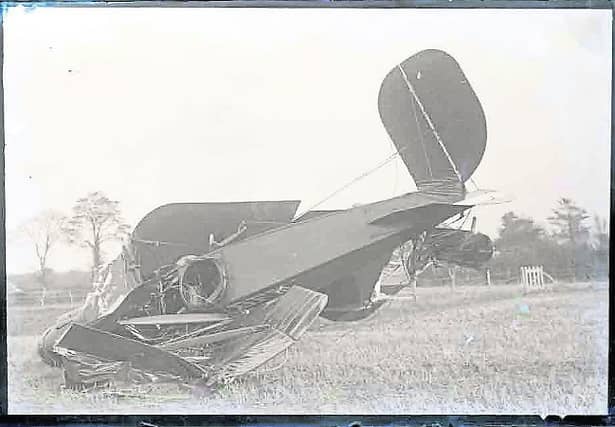

Local historian Liam Kenny on how a Ballycane crash marked the introduction of the Irish Air Force
This time of the year is known to newspaper editors as the ‘silly season’ when — given the disappearance of the courts and the councils on summer vacation — even the most trivial matter becomes elevated to the headline material.
However, there was nothing silly about a rumour that buzzed around Naas 100 years ago that a military plane had crash-landed into a field near Naas Hospital with two crew on board.
Not alone was the incident itself extraordinary for Naas on that eventful July day, but it also reflected a bigger story — that of the opening weeks of the Civil War with anti-treaty gunmen escaping from Dublin city after their siege in the Four Courts had been broken by their former comrades in the pro-treaty National Army.
The anti-treatyites navigated their way out of the metropolis and moved furtively across north Kildare in mid-July in an attempt to regroup and fight a rear-guard action among the west Wicklow hills — Ballymore Eustace, Blessington and Baltinglass, becoming flashpoints as they were pursued across the county boundary.
The embryonic National Army, under the leadership of General Michael Collins, dispatched units in pursuit including aircraft from a fleet of just three which bore Irish colours at Baldonnel aerodrome beside the Naas -Dublin Road opposite Rathcoole.
It was the first flight of such a combat patrol mounted by the fledgling National Army Air Service (soon to be renamed the Irish Air Corps) and it was to come to grief in a field at Ballycane immediately to the east of Naas.
The pilot was Major-General William McSweeney who, just the previous November, had been involved in an audacious plan to rescue Michael Collins and the Irish delegation from central London in December 1921 if the Treaty negotiations had collapsed acrimoniously.
McSweeney was among an elite band of Irish volunteers with piloting experience who had surreptitiously purchased an airplane at a London airfield and held it in reserve to fly the key Irish delegates out of the city if the British had attempted to detain the Irish representatives.
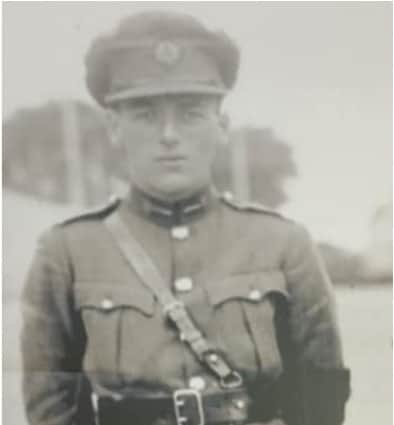
Major-General William McSweeney
By the spring of 1922, he was was tasked by Collins with setting up a new Irish air force with a handful of planes acquired from the departing British. Such was the paucity of qualified pilots in the new unit that, even though McSweeney was the officer commanding in Baldonnel, he still had to take controls for the inaugural combat patrol.
Flying a Bristol fighter, a single-engined biplane, McSweeney and his observer, Lieut Nolan, lifted off from the grass airfield at Baldonnel on the afternoon of July 16, 1922, to carry out the first combat patrol of the Civil War.
The plane was spotted over Naas by a vigilant Kildare Observer correspondent whose reporting carries a flavour of the novelty of not alone seeing a plane but of seeing a plane in Irish colours:
“On Sunday afternoon about 4.30 a Bristol biplane, with the tricolour painted on both sides, passed over Naas in the direction of the south.”
That was only the start of the drama because soon the plane was seen again: “A short time later it appeared to be returning, and then was seen to descend in the vicinity of Naas hospital.”
The report related that the stricken aircraft landed in a field the property of Mr. Stephen J Brown at Ballycane (to the east of Naas).
The landing, however, was not smooth: the plane’s undercarriage hit a rut and the machine ‘turned turtle’, coming to rest upside down with its wheels in the air.
Of the two-man crew, McSweeney escaped unscathed but his observer Nolan was knocked unconscious. It appears that the plane had run out of fuel forcing McSweeney to put it down for an emergency landing.
Locals, astonished by this apparition from the skies, rushed to the upturned plane to render assistance. Later, an armed guard from Naas military barracks secured the stricken craft. Townspeople must have watched in wonder as the following day the plane was towed through the streets behind a Crossley truck back to Baldonnel.
While County Kildare residents would not have been strangers to airplanes given that the British had flight school on the Curragh since 1914, it was nevertheless a novelty to be up close to an aircraft and an even greater novelty to find a plane marked in the colours of the new Irish Free State.
The last word might be left to the Kildare Observer correspondent whose report on the local reaction to the incident conveyed the excitement of aviation in the summer months of July 1922: “On Sunday, and prior to its removal on Monday, hundreds of people from the town visited the scene of the crash, this being the first occasion on which any of them had come in such close contact with the ‘Irish Air Force’.”
A hundred years later the Irish Air Corps (as it was later named) is rarely out of the skies of east Kildare with aircraft of all shapes practicing their formations and manoeuvres among the Lilywhite clouds ensuring that aviation in Irish colours is no longer the wonder that it was to our forebears of a century ago.