

THROWBACK THURSDAY: Restoration planned for Hill of Allen tower
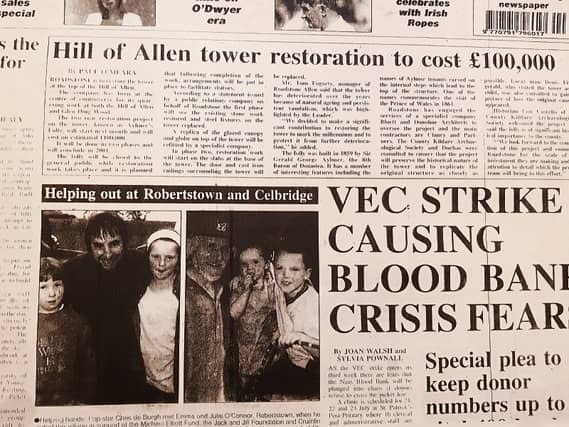

Report from 20 years ago
Theresa Murray takes a look back at story about the restoration of the Hill of Allen 20 years ago.
Roadstone is to restore the tower at the top of the Hill of Allen, the Leinster leader reported on July 8, 1999.
Read also: See more Kildare stories
The company has been at the centre of controversy for its quarrying work at both the Hill of Allen and Glending Wood. The two-year restoration project on the tower known as Aylmer’s Folly, will start next month and will cost an estimated £100,000. It will be done in two phases and will conclude in 2001.
The Folly will be closed to the general public while restoration works take place and it is planned that following completion of the work arrangements will be put in place to facilitate visitors.
According to a statement issued by a public relations company on behalf of Roadstone, the first phase will see the existing stonework restored and steel fixtures on the tower replaced.
A replica of the glazed canopy and globe on top of the tower will be refitted by a specialist company.
In Phase 2, restoration work will start on the slabs at the base of the tower, the door and cast iron railings surrounding the tower will be replaced.
Mr Tom Fogarty, manager of Roadstone Allen, said the tower had deteriorated over the years because of natural ageing and persistent vandalism which was highlighted by the Leader.
“We decided to make a significant contribution to restoring the tower to mark the Millennium and to protect it from further deterioration.”
The Folly was built in 1859 by Sir Gerard George Aylmer, the 8th Baron of Donadea. It has a number of interesting features including the names of 82 Aylmer tenants who were employed on the building, including four women, carved on the internal steps which lead to the top of the structure.
One of the names commemorate the visit of the Prince of Wales in 1861.
Historian Con Costello of the County Kildare Archaelogical Society welcomed the project and said the Folly is of significant historical importance to the county.
“We look forward to the completion of this project and commend Roadstone for the scale of the Investment they are making and the attention to detail which the project team will bring to the effort.”
The bones of a very large man described as a giant and popularly linked with the legendary Fionn Mac Comhail were unearthed during the construction of the tower. At that time the bones were reinterred in a hollow space under a sloping tongue of rock under the railing surrounding the tower. It is hoped that perhaps the bones may again be found and examined during the reconstruction and the Fionn mystery solved.