

The Kildare sailor who lost his life at sea after his ship was torpedoed during World War 2

Liam Kenny recalls the tragic case of a merchant seaman from Donadea
A tragic story of a Kildare sailor who never came home from the sea continues to engage more than 75 years after his death.
William Simms whose address was given as “Donadea, Co Kildare” died when his merchant ship was torpedoed off the cost of Portugal in February 1943.
The vessel of which he was the first engineer was the steam ship Kyleclare one of a handful of brave vessels bringing supplies to Ireland during the austere days of the second world war.
Ireland was all but starved of supplies of coal, petrol and grain during the war years.
The British naturally diverted all their merchant fleet to bring supplies to their ports as the German U-boat blockade began to take a merciless toll on cargo ships in the Atlantic.
The Irish Government belatedly acquired a couple of outdated vessels which were to form the core of Irish Shipping Ltd. and these, together with the a number of existing small shipping companies, attempted to sustain the country with fuel and other essentials.
The Kyleclare was owned by one such small company the Limerick Steamship Company. Although Ireland, being a rural economy, was reasonably well provided for with meat, dairy and root crops, other supplies which had to be imported were heavily rationed.
Were it not for the heroics of the men who crewed the handful of cargo ships, the country would have been deprived of coal and oil and other essential provisions.
The Irish ships sometimes sailed in convoys protected by Royal Navy vessels, but very often they had to ply the shipping lanes alone. One of the few countries that Ireland could trade with at the time was Portugal, a fellow neutral on the Atlantic seaboard.
This meant that the Irish crews had to sail from the waters of Lisbon across the full length of the Bay of Biscay and to the west of the English channel before making landfall at the ports of Dublin or Cork.
This was prime hunting ground for the German U-boats who were adept at picking off lone cargo ships unprotected by naval escorts.
And so, on the day in February 1943, William Simms and his crewmates must have felt a tinge of anxiety as they sailed from the shelter of Portugal’s Tagus estuary and out onto the grey Atlantic.
They had already seen what the destruction of war could bring as in July 1940 they had rescued crew from a British ship which had been sunk off Loop Head on the County Clare coastline.
Simms, aged 61, was one of the oldest on board, and one of the few from an inland county.His seventeen crewmates largely hailed from traditional sea-faring communities in Wexford, Galway, Clogherhead, and Dublin’s Ringsend.
The Kyleclare was a reasonably modern vessel, having built by the Caledonian Shipyards in Dundee, Scotland in 1932.
However, she was a small ship intended for short sailings between the ports on the west coast of Ireland and Britain.
Now, because of the war, she was forced to take on longer passages stretching her capacity and that of her crew to its limits.
And she was a freighter not equipped with any defensive armament to ward off preying U-boats.
Like other Irish merchant ships, she displayed the letters EIRE in big white paintwork on her hull in an effort to signal to belligerent parties that she was sailing for neutral Ireland.
However, in the fog of the oceans or the fog of war, such niceties meant little.
Two days after leaving Portugal, and making good progress she was sighted by captain Max Teichert, captain of U boat 456. The ship was a sitting duck for Teichert. She was alone, far from any naval help, and the weather was calm.
Teichert lined her up in his periscope and ordered his torpedo chief to fire three torpedoes at the Kyleclare.
Apparently, as the torpedoes left the tubes, the submarine rose higher in the water and he caught sight of the ‘EIRE’ markings on the ship’s hull.
But it was too late — the torpedoes were now streaming towards their target. At least two of the projectiles hit the Kyleclare and she disintegrated in a catastrophic double explosion. What remained of the hull sank almost immediately.
William Simms, aged 61, died immediately along with his 17 colleagues on the crew. He would never return to his home in Donadea far from the salty oceans on which he had plied his trade.
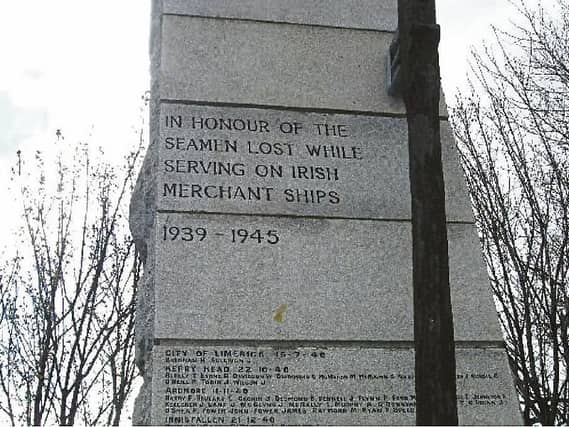
He and the other seamen who lost their lives bringing sustenance to Ireland during those desperate years are remembered each November at the memorial for merchant seamen at City Quay in Dublin.