

Kildare history: Court raided as Kildare defies the British during War of Independence

Liam Kenny looks back a century to when Kildare County Council became embroiled in the national struggle for Irish independence …
The coming year will mark the mid-point in the centenary reflections of the War of Independence which raged in Ireland from 1919 to 1921.
Already there is a full pipeline of publications, seminars and television documentaries looking back on the fraught years of the independence war. Much of the commentary highlights the military conflict between the Irish Republican Army on one hand and the various armed manifestations of the British state on the other — the Royal Irish Constabulary, the dreaded Black and Tans and the feared Auxiliaries.
However, less well known than the shooting war was the manner in which Irish nationalists worked to undermine the British government in Ireland by setting up a parallel Irish government and administration under the auspices of the new Dáil Éireann elected in 1919.
In the forefront of this effort was the struggle in the Council chambers of the land. The arm-wrestle between, on the one hand, the civil servants of the British-established Local Government Board as they attempted to hold on to their controlling function over local authorities from their Customs House offices, and on the other, the revolutionaries turned administrators of the emerging and subversive Dáil Éireann Government departments is echoed in the records of the local councils.
The surviving material shows that the battle to determine the future administration of the country went on in the dusty corridors of county halls as well as on the hillsides where the flying columns marched.
To the public in general, the Customs House on Dublin’s north quays was one of the main manifestations of British control in Ireland, responsible for directing a wide range of local services, and an important element in the machinery of public taxation.
For a time there was something of a political mismatch between the Sinn Féin Dáil and the Home Rule County Council. The previous elections had been in 1914 when the Councillors elected were largely Home Rule in their political ambitions. This meant that they aspired to independence for Ireland but saw the country remaining within a context of the British Empire.
However, the 1916 rebellion injected a militancy in the nationalist campaign which was to reverberate in the following years. The 1918 parliamentary elections saw Sinn Féin sweep the boards in the southern three-quarters of the country.
Two years later, the local government elections of 1920 took place against the febrile background of the War of Independence and were certain to bring in a council with a much sharper nationalist thrust.
The elections to the city and town local authorities in January 1920 had set the scene on a national basis with Sinn Fein gaining control of seventy-two out of 127 corporations and town councils on the island of Ireland.
This trend was maintained in the county council elections of June of that year, with Sinn Fein winning the majority on 28 of the 33 county authorities.
The newly constituted councils considered themselves an integral part of the nationalist struggle. According to the First Report of the Sinn Féin Department of Local Government, the post-election councils “challenged the authority of the Imperial Parliament by refusing to recognise the control of the Local Government Board and by making declarations of allegiance to Dáil Eireann.”
The situation in Kildare County Council reflected the national transformation in the balance of power on local government councils outside of Ulster.
Out went names associated with the establishment — no matter how benevolently disposed towards Home Rule — such as of Lt. Col. Frederick Fitzgerald of Maynooth, George Wolfe of Furness, and Matthew Minch of Athy.
In came activists under the Sinn Féin banner such as Eamonn Ó Modhráin of Suncroft and Domhnall Ua Buachalla of Maynooth whose use of the Irish forms of their names signalled the intensity of their political convictions.
The new council lost no time in laying down the markers of its political sympathies and of its attitude to the British administration structure. The first business of the first meeting after the local government election was to elect Domhnall Ua Buachalla as the council’s chairman — a figure with strong nationalist connections in North Kildare who was later to be appointed by Mr de Valera as Ireland’s last Governor General.
The second item of business was to admit a deputation from the Gaelic League consisting of Arthur O’Connor, TD; a Dr Grogan, and a Fr O’Brien. Not alone did the councillors receive the deputation with alacrity but they took on board with enthusiasm its advocacy of the Irish language as a central part of the building of a new and independent Ireland.
The pre-eminence given — at least symbolically — to the Irish language was backed up by an explicitly political motion which fired the opening shot in the struggle of transferring the Council’s loyalties from the British-established Local Government Board to the Department of Local Government set up under Dáil Eireann. This motion marked the entry of the Council as a full participant in the administrative battle running concurrently with the military conflict then at its most
intense.
The Council’s motion read: “That this council... hereby acknowledges the authority of Dáil Eireann as the duly elected Government of the Irish people and undertakes to give effect to all decrees duly promulgated by the said Dáil Eireann in so far as same affect this Council.”
It is an illustration of the far-reaching network of influence being created by the members of the fledgling Dáil Eireann government that the KCC members felt it possible to give their motion an international airing, resolving that it should be forwarded to “the Republican Minister for Foreign Affairs for transmission to the Governments of Europe and to the President and Chairman of the Senate and the House of Representatives of the USA.”
The Council’s determination to wield the tools of administration as part of the armoury of the nationalist struggle was emphasised by another motion passed at that same meeting which ordered “that every possible obstacle be placed in the way of the British Government in collecting taxes and otherwise”... and specifically instructing the council’s officials not to let the lists of ratepayers or the Council’s staff records fall into British hands.
The Council’s determination that urgent steps be taken to transfer the power of even the most routine aspects of local authority functions is illustrated by a resolution of August 1920 specifying that the operation of the weights & measures inspectorate be taken out of the hands of the RIC.
A secondary theme to the nationalist re-orientation of the council’s political sympathies and official functions was the increased status given to organised labour. A motion was passed in August 1920 directing that “only trade union labour be employed” on the Council’s direct labour schemes.
This preference towards the Trade Union movement was motivated, in the first instance, by a desire to reward the unions for their support of the nationalist struggle as another motion passed by the Council makes clear, ‘That we the members of the Kildare County Council in recognition of the good services rendered by Trade Union Labour hereby call on all Republican Employers in Co. Kildare to employ none other than Trade Union Labour”.
Returning to the central issue of the Council’s transfer of loyalty to Dáil Éireann, the fight back from the Local Government Board was rapid and predictable.
In August 1920, a letter was read to a KCC Finance Committee meeting from the Local Government Board backed by a similar communication from the Under Secretary in Dublin Castle, threatening to with-hold grants from local authorities who refused to conform with its instructions. The KCC members were defiant the minute recording ‘it was decided to take no action in the matter’.
However, more than rhetoric was needed if the Council was to make effective its attempts to cut off links with the Customs House.
The people who controlled the income and bank holdings of the Council were in a position to control all its activities. It was vital that the Council’s resources were not left vulnerable to being seized by the Local Government Board.
On September 1, 1920, the Council held a special meeting in which it was resolved to make “such arrangements as are necessary in connection with the
Treasurer-ship for protecting the finances of the Council”.
This was backed by another motion depriving the Hibernian Bank (Naas) of the Treasurer role for the Council.
A special committee of the Council set to work immediately on emergency plans for keeping the Council’s assets out of British hands making arrangements so secret that they could not be detailed in the official minutes, a timely precaution as will be shown later.
The committee ordered that all further payments to the council be directed to Mr Patrick Field, the Council’s Accountant, “to whom the committee gave private and confidential instructions as to the disposal of the money”.
The contest for control of local administration took other direct forms.
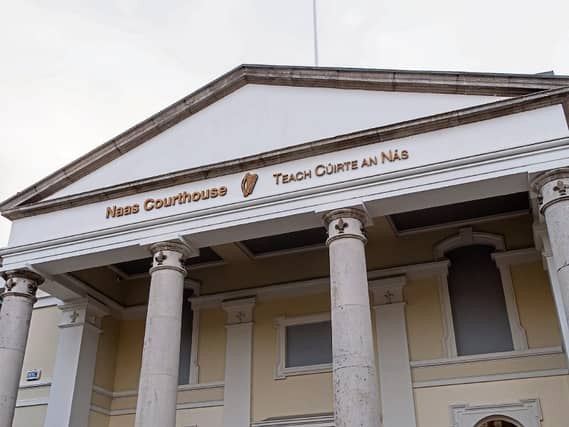
The first entry in KCC’s ninth Minute book, dated November 22, 1920 records the Secretary reporting that “a raid had been carried out by the RIC this morning on the Courthouse and the Council’s current minute book and letter book, also the abstracts of Collector’s lodgement’s and correspondence received from Dáil Éireann, had been taken possession of by the raiding party.”
Subversive raids
Raiding the offices of a body regarded as subversive is a common feature of the reaction by government authorities in order to glean information and frustrate the activities of the organisations which threatens their position. It is significant that among the documents seized were the rate collectors’ lodgements which showed the source and destination of the council’s main source of income.
As 1920 drew to a close Kildare County Council found itself drawn deeper into the independence struggle. Its head office at Naas courthouse had been raided by the RIC and its records confiscated. And some of its elected members were ‘on the run’ swopping their council seats for firearms in those turbulent months.
Local authorities such as Kildare County Council may not have been in the frontline of the independence struggle but from the local elections of 1920 their political aspect complemented the fighting forces of republicanism.
In parallel, the local authorities as organisations in their own right were important actors in the drama of undermining the institutions of one regime and replacing them with those of a new independent government.