

KILDARE COLUMN: John Condon, the forgotten boy soldier of WWI
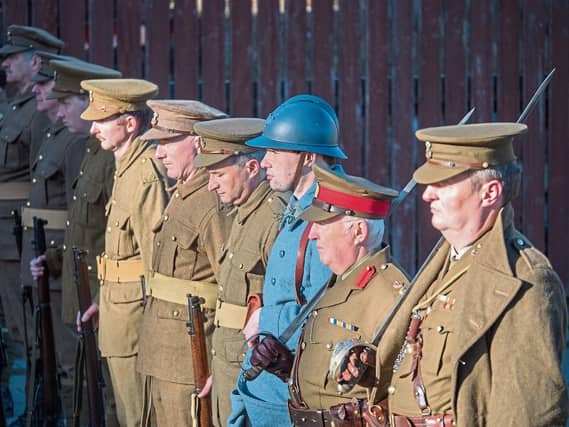

Robert Mulhern remembers the story of the youngest soldier killed during the Great War
IT’S a few years now since I read James Durney’s Far from the Short Grass — the stories of Kildare men in two World Wars and I’m sure the local author has an equivalent of sorts to the story of John Condon from Waterford.
Condon is listed as the youngest casualty of the Great War by the Commonwealth War Graves commission.
His story has been well documented in the national media in recent years but curiously enough, I’ve never heard it referenced in Britain.
This, despite his grave — in Belgium’s Poelcapelle Cemetery — being the most known and visted of any solider who died in the first World War.
I first learned of John Condon’s story when it was little known and I was studying journalism in Ballyfermot in 2004.
And post Armistice Day, his life is worthy of marking on these pages because for so long his story barely registered — anywhere, even within his native county .
But in March 1915, John Condon was part of the 2nd Battalion of the Royal Irish Regiment (RIR) marching through the small Belgian town of Ypres en route to the Western Front.
Condon was then aged 14. He joined the army for an adventurous life and in the belief, which was one shared by many, that their presence in the ranks of the British Army would buy future Home Rule for Ireland.
Within two months Condon and almost the entire 2nd Battalion of the RIR was dead after succumbing to the effects of a German gas attack.
The Boy Soldier, as he is now known, John Condon grew up in the Ballybricken area of Waterford city at the turn of the last century.
Waterford then had a population of about 20,000 and according to local archivist Donal Moore. The Condon family’s social level would have been very poor and the young John would have left very little footprint.
In 2004, I spoke to the deceased soldier’s nephew who is also named John Condon, but from Ferrybank in Waterford.
He recalled memories of older family members making reference to the boy soldier saying: “It was often recalled that John as a child would run around Ballybricken with a wooden gun telling people he was going to join the army.”
Before he left Ireland, John worked as a boy bottler on the quay in Waterford and his yearning for adventure may have been stirred by John Redmond who encouraged local men to join the Allied war effort.
This he said would make a major contribution to the attainment of Home Rule.
Soon after John joined the Special Reserve Defence Force and began his training in the Army barracks in Clonmel.
He clearly lied about his age but according to John Condon of Ferrybank his namesake was “a big hardy young fella who looked older than his years” and after Clonmel, John was assigned to the 2nd Battalion of the RIR, (12th Brigade 4th Division).
In December 1914, his battalion was posted to Flanders, but so many never returned.
In the Belgium town of Ypres a roll of honour at the Menin Gate lists the names of 56,000 men who died defending the town.
A large proportion of those 56,000 bodies have never been recovered. For those that were, it was a slow and painful process, as many men were simply buried where they fell in battle.
It took eight years before John’s body was found with his boots and braces still intact. Allegedly, he was identified by his army service number, which was stamped on his boot.
It was only during this identification process that John’s age at time of death was established.
The War Office in England was to later confirm that Condon was one of 70,000 Irish men killed during the conflict.
When contacted about his death the deceased soldier’s family were unaware he’d even been fighting at the front.
And while those lucky enough to survive returned to their families the changing political landscape meant that they were now treated with suspicion.
As a consequence the story of John Condon sat uncomfortably with the Irish Government of the day.
And it’s only in recent years that the story has been given its dues in Ireland.
Robert Mulhern is a London based journalist contracted to RTE's The Documentary on One. To contact him, email [email protected]