

KILDARE BEER COLUMN: Judging beer contests — it’s a tough job, and we’re up for it!
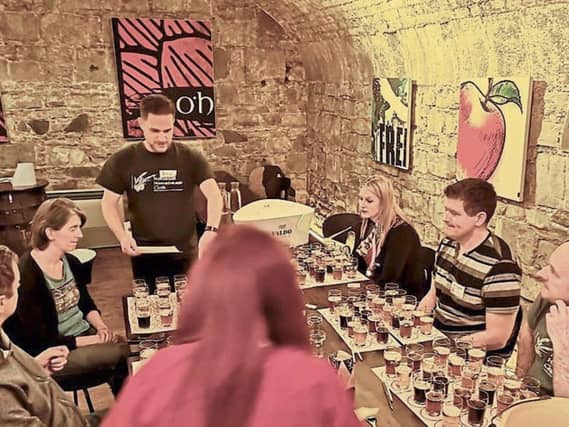

Judith and Susan Boyle give their views
Recently we had the honour of judging the National Brewing Championships organised by the National Homebrew Club.
Judging beer is a great way to learn about styles and to hone one’s olfactory skills.
It requires a lot of smelling and thinking and tasting and writing. You also need an excellent working knowledge of beer styles, what characteristics are appropriate and an ability to detect and identify undesirable traits and faults.
The National Homebrew Championships follows the Beer Judge Certification Program (BJCP). The BJCP is a non-profit organisation formed in 1985 in the Unites States.
Its aim is “to promote beer literacy and the appreciation of real beer, and to recognize beer tasting and evaluation skills”.
It is a standards-based organisation which supplies qualified judges to both amateur and commercial brewing competitions. The BJCP promotes the appreciation of beer styles, and publishes a beer style guide; and also campaigns for the accurate production of these styles by brewers.
When judging beer in a beer competition following the BJCP guidelines, the most important consideration is if a beer is true to style.
On cracking open a bottle of beer, the drinker has a reasonable right to know what they expect to find in their glass. A beer should be in keeping with the style to which it was brewed, the description on its label and the competition category it was entered into.
Sometimes, judges can come across an excellent beer that was entered into the wrong category. This is unfortunate, as even a well-made beer will not do well in a BJCP competition unless it is entered into the appropriate category.
Tasting beer all day long might sound like a dream job — and for the most part it is — but at times it is challenging. Palate fatigue is an issue, as a judge has to be mindful to assess the first beer as fairly as the last beer they taste.
With lots of entries or strong flavoured or high alcohol beers this can be difficult. Taking breaks between beers for water or a cracker to cleanse the palate can help alleviate this.
A beer judge learns very quickly to acknowledge their personal bias towards beer styles, whether positive or negative, so they can judge a beer fairly on the merit and quality rather than personal likes or dislikes.
This does not mean a beer judge doesn’t wrinkle their noses when faced with beer styles they are still learning to love, but we can assess any beer for faults and decide if a beer is true to style.
In all beer competitions it is not unusual to come across badly-made or faulty beers. At the National Homebrew Championships, the focus is on helping the brewers to improve.
The aim is to give constructive, encouraging feedback. These brewers brew for the love of beer, not for financial gain. This means they have often spent considerable time preparing their entry to the competition. They want to brew something delicious and drinkable.
Brewing is time consuming, and no brewer in history sets out to make bad beer. All brewers can learn from mistakes.
Unlike a drinks producer whose production is dependent on a single harvest such as wine or cider makers, brewers’ grain can be stored. This means that brewers can brew often and their skills improve quickly because brewers are not confined to brewing at just one time of year.
Often the beers in this competition show great imagination and showcase the finest ingredients.
Unencumbered by the financial restrictions of commercial brewing, homebrewers can use ingredient that may be considered too expensive to use in the quantities needed for larger batches.
During the competition judges are paired. They judge independently and then come to a consensus about the beer final mark.
Fairness
This is a fair way to judge as each person’s sense of smell and tastes is unique to them.
Some people are more sensitive to specific aromas and flavours and will notice these more so it is important for a beer judge to be aware if they are either sensitive or unable to detect certain off flavours and smells.
It also means that judges can learn from each other as people have different areas of expertise.
There were many beers of a very high standard in this competition and clearly a lot of effort and time has gone into the entries.
In total there were 46 categories judged and just under 180 beers judged. Oisin Dorgan from the Kilkenny Home brew club was awarded Best of Show and Best Brewer of 2019.