

HISTORY: Tranquility of rural road near Naas shattered by plane crash
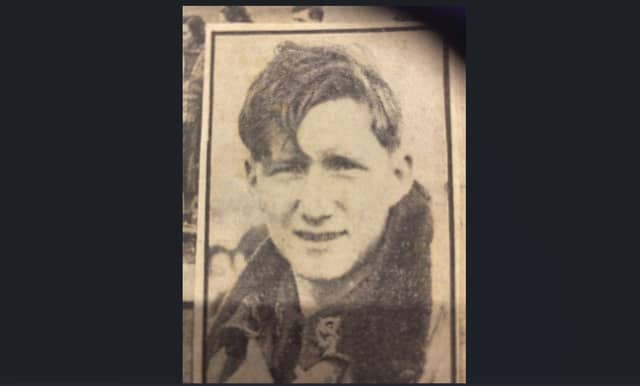

The tranquility of a 1940s rural townland south of Naas was shattered when an aircraft plunged from the sky fatally injuring its pilot.
Sergeant Pilot Michael McLoughlin died when his plane struck a tree and impacted the ground in the townland of Sillagh straddling the road from Naas to Ballymore Eustace.
The crash seventy-five years ago is scarcely recalled in the locality today but in March 1949 it made the front pages of the national press.
Its media prominence was due to the evidence of local eyewitnesses who gave graphic testimony of the aircraft’s final moments.
Sergeant Pilot Michael McLoughlin who was a great-nephew of 1916 patriot Padraig Pearse was an experienced Air Corps pilot based at Baldonnel aerodrome.
On the afternoon of 23 March 1949 he took off in a high-performance training machine – for a general purposes flight. He was seen by local man Mr Gerry Headon approaching the locality of Sillagh. But Gerry Headon was no normal witness – by notable coincidence he too had trained as an Air Corps pilot but at the time was not on active duty and was working at the Headon family farmstead at Sillagh. As an experienced flier he was able to give a well-informed account of the plane’s trajectory immediately before the accident.
He told an inquest the following day of how he noticed the plane approaching from the north-east in straight and level flight and he paid no more attention until he saw it descending and making a circling manoeuvre close to his position. It then came in extraordinarily low with its engine at high power but failed to clear a fifty-foot tree adjacent to the road. The plane struck the tree and plummeted out of his sight until he heard the thud of its impact with the ground just beyond the Doyle farmhouse in the field across the road from the Headon holding.
Among the first on the scene was Miss Brenda Doyle who had glanced up from her room in the family farmhouse and watched in horror as the plane seemed to be headed for the house.
Fortunately, it missed the building but careered across a field beyond the farmyard shredding
wreckage before it came to a violent halt. Ms Doyle ran to the spot, joined by Gerry Headon, and with difficulty extricated the pilot from the wreck.
It was a shock for Mr Headon to realise that the stricken pilot was his close comrade from the Air Corps, Michael McLoughlin. Indeed, Gerry Headon and Michael McLoughlin had flown together in a similar plane during their Air Corps service when they had shared the same training class for two years.
They were joined at the crash site by Mr Thomas Doyle who while working in a nearby field had seen the plane swoop low over Sillagh. Together they improvised a stretcher from a door and brought the injured pilot to the farmhouse. However, despite their ministrations and the later arrival of an ambulance from the Curragh Military Hospital with Capt. Boylan, Medical Officer in attendance, his life could not be saved.
Fr Eugene Crosbie, C.C., Ballymore Eustace, came to the scene and administered the last rites.
Soon on the scene were press representatives and the Co Kildare air crash made the front pages of the “Irish Press” the following day and prominent inner-page stories in the “Irish Independent”, “Cork Examiner” and other journals across Ireland.
At the Inquest the following day presided over by the Kildare County Corner, Dr Jeremiah O’Neill, Mr Headon said that it was his opinion that Sergt Pilot McLoughlin had come so low “because he knew me” -a view he reiterated at an Army Court of Inquiry in Baldonnel the following month.
Air Corps technical staff told the inquest that the airplane has been subject to inspection on the morning of its fatal flight and was found to be in perfect mechanical condition. It had already been flown that day by an Air Corps officer who confirmed that it had was fully controllable. It was also noted that weather conditions were fine on the afternoon of the accident.
The accident was subject to further scrutiny at an Army inquiry the following month when senior officers heard evidence from Air Corps personnel. Sergeant Pilot McLoughlin was described as a careful pilot who had very wide experience at the controls of a variety of aircraft. His logbook showed that he had flown a range of aircraft types since he joined the Air Corps from the infantry in 1943. His record showed over 300 flying hours including piloting the Hurricane and Spitfire aircraft – renowned for their combat performance in WW2 – and in the twin-engined Anson plane.
Ironically, he had made positive headlines just three weeks previously when a different model of plane which he was piloting over Dublin city lost power – this time because of an engine fault – and he skillfully guided it away from the housing estates to land without injury in a playing field in Crumlin.
As regards his fatal flight his commanding officer said that it was a general handling flight with a secondary aim of testing the ‘hood’ used for blind flying training. Low flying was a regular feature in a pilot’s flying practice but had not been specifically planned for the accident flight.
The inquiry board concluded that Sergeant Pilot McLoughlin had collided with a tree which precipitated the crash.
On the question of the plane’s low height beside the home of his Air Corps colleague, Gerry Headon, the inquiry did not find any evidence of communication between the two comrades which would have prompted the pilot to make an abrupt descent over his friend’s Sillagh residence.
Sergeant McLoughlin’s funeral took place from Arbour Hill church in Dublin to Glasnevin cemetery.
The chief mourner was his young widow accompanied by family members including Senator Margaret Mary Pearse, brother of 1916 patriot Padraig Pearse and great-aunt of the deceased.
There was a strong attendance from the Government and the Army.
Despite seeing air tragedy at such close quarters, Mr Gerry Headon of Sillagh went on to have a distinguished career in Irish aviation and piloted the Aer Lingus aircraft which transported Roger
Casement’s remains to Ireland in 1965 resulting in the name Casement aerodrome being conferred on the Air Corps base at Baldonnel.
He later progressed to flying Boeing 747s on the prestige Aer Lingus routings to America. After retirement from the national airline, he reinforced his place in Irish aviation history by becoming the first Chief Pilot of a start-up airline known as Ryanair, then a small operation flying a commuter plane on the Waterford-Gatwick routing.
Today the townland of Sillagh retains its rural aspect highlighted by the white-washed farmsteads of Doyles and Headon on the road to Ballymore Eustace.
Few of the motorists who travel this road at speed will notice the white iron cross nailed to the tree struck by the plane on its final trajectory – the only indication that a life had been lost when an air disaster unfolded over the tranquil pastures of east Kildare.