

Derby fever infects Kildare courts

The day the lawyer faked an emergency to get to the Curragh Derby
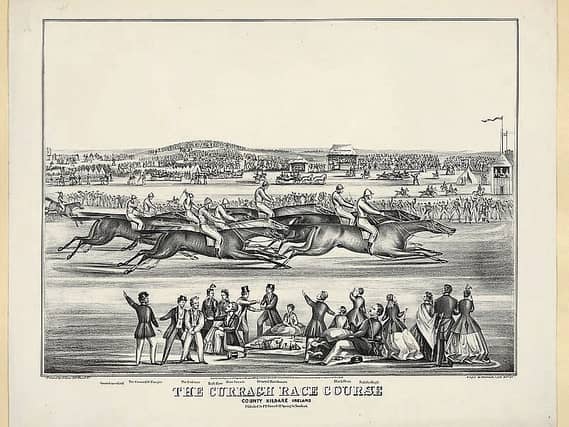
Come back St Brigid. Your presence is needed on the Curragh pastures made famous by your legend — because the lustre which adorned the Curragh plains by virtue of your celebrated monastery at adjacent Kildare looks set to be overtaken by flying hooves and fashionable hats as the Derby extravaganza passes the starting post.
And this is not some modern day commentary on the exuberance of style, fashion and merry-making which descends on the plains in late June. Indeed, as far back as 1890, a scribe in the local newspaper was making reference to “the feast of St Derby” such was the almost religious nature of the pilgrimage made by racing devotees from near and far to see the Blue Riband fixture of the racing calendar played out on the short grass of County Kildare.
While Derby Day was spoken of in quasi-religious tones in the late 19th century, its allure also penetrated the hallowed halls of justice in a later generation. At a sitting of Naas Quarter Sessions Court in 1920 the presider of the bench — Judge Drumgoole — was obliged to make concessions to the reality of Derby fervour in the county. He was reported as displaying a tactful and sympathetic consideration of the sporting instinct of Kildare men at Naas Quarter Sessions in referring to an application made to him by Mr Tracy, solicitor, on behalf of some of the jurors.
The solicitor made the suggestion that the court sessions should not be fixed so as to clash with the Curragh races, as had frequently been the case in the past. This clash was the cause of much avoidable disappointment to many — not alone jurors but witnesses, advocates, and others who were torn with conflicting emotions between their love of sport and their desire to do their duty — or perhaps it would be more correct to say their disinclination to submit to fines of two pounds per day for absence from the court if they happened to be jurors, and to goodness knows what losses if they belonged to any of the other sections.
The local court reporter weighed in by writing that that there was no reason why the court sessions should not be held in weeks other than those fixed for the Curragh races, and a concession thus made to local sentiment. From the point of view of justice the change would be desirable, for human nature being what it is, it could hardly be expected that jurors would pay the attention to their duties which would be desirable and essential, if running through their minds while in court were thoughts of the Curragh and in their hearts feelings of envy for their compatriots who were free to enjoy the sport.
Fortunately, the benign Judge concurred, saying that the sporting spirit was one to be encouraged and he promised that in the fixing of future Quarter Sessions the matter would have his sympathetic consideration.
Further, members of the legal profession in the county revealed how they had adopted various ruses for breaking free from the dull plod of court business and escape to the racecourse for the Derby. One lawyer confided that, in a previous year when the court coincided with Derby Day, he had arranged for a friend to send a telegram to the court with the message ‘Come home, urgently wanted’.
The telegram was handed in to the court clerk Mr Dane, who called out the name of the addressee to whom he handed the buff envelope. The envelope was opened and the telegram read by the race-loving lawyer who, maintaining a serious countenance, handed the message to the judge with a request that he be excused from court for the rest of the day. The Judge replied: “Oh, very well; excused.”
The lawyer solemnly took leave of the courthouse and, once at a safe distance from its precinct, changed into his racing finery and headed for the Curragh.
Thinking his ruse had gone unnoticed by the judiciary, he enjoyed the sport and thought nothing of his escapade until some days later he was reading through the following week’s ‘Kildare Observer’ court reports. In it he saw a report of his telegram incident in court but with a post-script to which he had been oblivious.
The paper reported that after he had left the courtroom the Judge commented to those remaining in court: “He will still be in time for the first race.” The judge was not at all fooled.
The passion for Derby Day transcended into another pillar of local society — that of local government. A report in the local press of 1908 headlined an episode from the Naas Board of Guardians (health board) with the phrase “Truly, sporting Kildare!” The otherwise copper-fastened meeting day of the Guardians in June was to be deferred for a reason which has earned fame for County Kildare and made it a synonym for sport.
At a previous meeting, a member had nonchalantly remarked that as the next meeting day was Derby Day he presumed there would be no meeting of the Board. The journalist covering the meeting added the commentary that if a quorum of three members turned up for the Derby Day meeting, the business would have to go ahead. However, he posed the rhetorical question — “will there be found in the composition of the board three members sufficiently deaf to the appeals of sport to attend the monotonous, unexciting affairs of the Poor Law system?”
It is safe to conclude that there was no meeting of the Board on Derby Day 1908.
However, while extracting oneself from legal or civic duties to attend the Derby might have been a priority on the day, getting to the racecourse itself presented a whole other range of challenges.
The local paper in June 1902 carried a brace of letters from racegoers furious at being delayed by overcrowding issues at Sallins railway station.
One letter was datelined “Sallins Station, 26 June 1902” and addressed to the Editor of the Kildare Observer in Naas. It was written in such graphic terms that the reader could identify easily with the frustration of the Derby-bound passenger:
“Dear Sir — Here I am broiling in the sun, with about 300 others, awaiting shelter of a train to carry me to the Curragh.
Two specials overcrowded to suffocation have passed, and here we await another. One would expect provision would be made for the crush of the June meeting.
“We are only poor Irish, and cannot expect much consideration, still — some should be given.
“Yours — A Tullowman.”
Tullowman had arrived in Sallins on the branch line that once ran from Tullow in Co Carlow through Baltinglass and Naas to join the main line at Sallins.
His discomfort was echoed by another frustrated correspondent:
“Dear Sir, Would you allow me space to draw the attention of those responsible for the long wait that anyone going to the Curragh races had to endure at Sallins. Surely something can be done.
“Such a big contingent come nowadays on the Tullow branch, a special train would be a great convenience — Yours etc. Derby Day.”
While rail travel — since the lamented closure of the Curragh siding — no longer features greatly as a vehicle to access the Derby festivities, it is nonetheless hoped that the 21st century iterations of the event will be just as popular with racegoers be they lawyers, councillors or people with no title other than enthusiasts of fine racing on the celebrated turf of the Curragh plains.