

Kildare sculptor Aidan Harte talks about being inspired
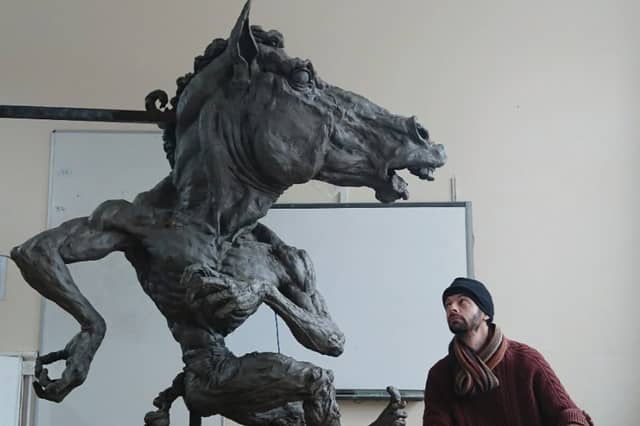

The talented Kildare sculptor talks muses and memories
On any given morning, Aidan Harte walks his dog across a canal bridge in Co Kildare where, according to local lore, ten rebels were executed in 1798. It is said that after midnight their skeletons can still be seen hanging in the dark.
For Harte, such stories are not mere curiosities - they are creative fuel.
“Kildare has lots going on culturally,” he said, pointing to developments such as the forthcoming sculpture park at Burtown House. “But what I love is that you’re never far from a story.”
That sense of layered history — where folklore, rebellion and local characters overlap — runs through his work. Last year, he created a small sculpture inspired by a Naas musician immortalised in a rhyme: “Jack Lattin, dressed in satin, dropped down dead from too much dancing.” Lattin, who died in 1736 aged just 21, is buried behind St David’s Church. Legend has it he once bet he could dance his way home from a party. He won the wager — but died the following week.
These fragments of Kildare’s past, half-fact and half-fable, often find new life in Harte’s bronze figures.
He is currently developing a statue of St Brigid, inspired by the renewed celebration of her feast day in recent years. In sculpture, he explains, everything must be conveyed through a single pose.
“You must capture your subject’s essence in one gesture,” he said. His Brigid will not be passive or sentimental. Instead, he envisions “a strong Kildare woman facing into the wind, an enormous cloak billowing behind her.”
Though his finished works stand in galleries and public spaces, Harte’s process begins quietly — on paper.
“Sculptures and paintings, it all begins on paper,” he said. He sketches repeatedly, often producing a dozen variations before settling on the most dynamic pose. From there he creates a small clay maquette, known as a bozzetto, to explore the form in three dimensions.
Once satisfied, he hires a model to study anatomy and weight. “You need to understand how a body holds itself — where the tension lies,” he explains.
The technical process that follows is both meticulous and physical. A steel armature forms the internal skeleton, supporting layers of clay that grow heavier as detail increases. Working on a turntable or wheeled platform allows him to adjust angles and lighting as the figure evolves.
Over days and weeks, rough surfaces are refined, broad shapes softened into muscle and fabric. When the clay version is complete, a mould is made and the work moves to the foundry, where the traditional lost-wax casting method transforms it into bronze. The final stage — patination — brings colour and character.
His most recent public commission in Tipperary will likely be finished with a traditional sea-green verdigris patina, a nod to classical statuary.
While Harte studied art in Florence, he dreamed of creating statues like those dominating the Piazza della Signoria. Today, his bronzes are exhibited in prominent Dublin settings such as the Róisín Lafferty Gallery. Yet his ambition has always been to create public art that sparks conversation.
In 2020, that wish came true — dramatically.
Commissioned to create a sculpture for the town of Ennistymon in Co Clare, Harte chose The Púca, a shapeshifting fairy from Irish folklore, often associated with galloping across the plains of Kildare. Before the sculpture could be erected, however, it was denounced from the altar by a local parish priest as “a pagan idol.”
The controversy that followed - dubbed the “Púca Panic” - spiralled into what Harte wryly describes as a cultural storm. Songs, poems, murals, cartoons and documentaries followed. International media outlets sought explanations. “I found myself trying to explain to the BBC and the Guardian why my lovely horse was controversial,” he recalls. Euronews ran the headline: “What is a Púca? And why has it caused an ideological war in Ireland?”
In 2022, the tale ended happily. The sculpture, affectionately nicknamed the “Scare from Clare,” was erected in the Burren near the Michael Cusack Centre. Today, tourists polish its big toe to a shine while making wishes.
Harte believes the episode illustrates the power - and risk - of figurative public art.
“Commissioners and curators are terrified of the public,” he said. “That leads to a glut of abstract art on our roads and town squares. It’s safe. Nobody likes it; nobody hates it.”
He argues that figurative sculpture, though riskier, connects more deeply. “Ordinary people struggle to relate to abstract forms but respond readily to bodies, to characters.” He points to global icons — New York’s Statue of Liberty, Copenhagen’s Little Mermaid, Florence’s David — as examples of sculpture shaping identity.
Closer to home, he cites Athy’s statue of Shackleton as a work that captures that alchemy. He is surprised that Kilcullen or another Curragh-side town has not yet commemorated Dan Donnelly, the bare-knuckle boxer who defeated England’s champion in Donnelly’s Hollow in 1815. “His arms were so long, he could tie his shoelaces without bending down,” Harte said with a grin.
Currently shortlisted for several new commissions, Harte is also thinking long-term about Ireland’s shared narratives.
“A nation needs common stories as much as a common language,” he said. In a lecture at Naas Library last year, he argued that contemporary sculptors should follow the example of Oisín Kelly, who brought modernist sensibility to Celtic myths such as the Children of Lir.
Thanks to Hollywood, he notes, many Irish people are now more familiar with Viking legends than their own mythological cycles. Yet the Ulster Cycle — with figures such as Cú Chulainn, Queen Maebh and Lugh of the Long Arms — offers epic material. Lughnasa, the autumn harvest festival, celebrates Lugh’s victory over Balor of the Evil Eye, king of the Fomorians.
In years to come, Harte hopes to give such primal personalities tangible form in bronze — sculptures rooted in Irish soil yet speaking to modern audiences.
For now, he continues his morning walks across that haunted Kildare bridge, listening for echoes of the past. In Harte’s hands, those echoes rarely stay silent for long.